Research June 1, 2026
Transformers from Scratch
My working notes on Transformers from Scratch, part of my learnings from the ARENA course.
Basic intuition behind Transformers: you feed in a sequence of length N, then sample from the probability distribution over the N+1-th word, use this to construct a new sequence of length N+1, then feed this new sequence into the model to get a probability distribution over the N+2-th word, and so on.
Training
- Model is trained on next token prediction.
- For each 100 tokens given, it produces 100 probability distributions (1 for each), where each distribution p(i) has the probability distribution over i-1 tokens.
- For every sequence n, we have n different predictions in a transformer:
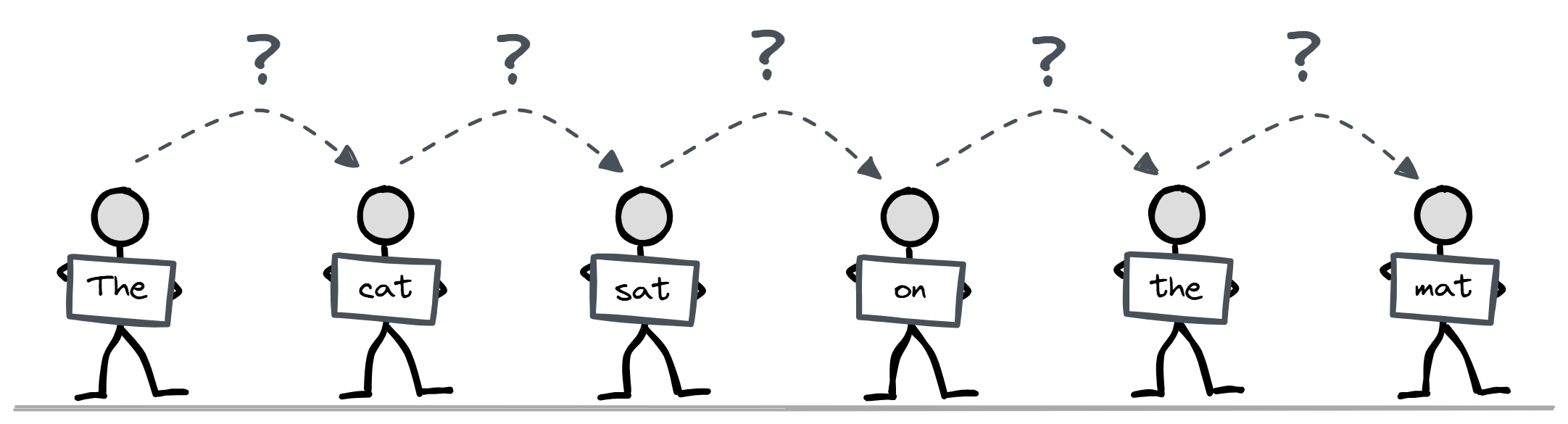
- n input tokens, output of transformer is n vectors - (“the” distro, “the cat” distro, “the cat sat” distro and so on …)
- where X distro is the vector representing the probability distribution of what can come after X
Transformer Inputs - Tokens
- to_tokens converts text to tokens, and prepends them with BOS (beginning of sequence), which can be removed with
prepend_BOS=falseinto_tokens,to_str_tokens,model.forwardand any other function that converts strings to multi-token tensors.- BOS useful to denote beginning of sentence, and to act as rest for attention heads.
- BOS=EOS=pad tokens in GPT because they hold the same meaning since text is read left to right.
- Input to transformers is a sequence of tokens (integers), not vectors.
- These integers are converted to vectors via lookup table (eg, one hot encoding).
Text Generation Steps
Refers to cell in notebook.
- Input: One sequence with length seq_len would have this shape after tokenization:
(batch, seq_len) = (1, seq_len). - Shape of output (logit):
(batch, seq_len, vocab_size). Vocab_size comes from transformer. - The
[i, j, :]th element of our output is a vector of logits represents the prediction for thej+1th token in theith sequence.
Summary
- Transformers predict next token one by one in a causal left-to-right way.
- Tokenizers convert language to integers.
- Integers are converted to vectors using lookup table.
- Output is a vector of logits (one for each input token), we convert to a probability distn with a softmax, and can then convert this to a token (eg taking the largest logit, or sampling).
- Now this output is appended to input and sent as input again (i.e, autoregressive).
- Meta level point: Transformers are sequence operation models, they take in a sequence, do processing in parallel at each position, and use attention to move information between positions!
Important Code Steps
tokens = reference_gpt2.to_tokens(reference_text).to(device)
logits, cache = reference_gpt2.run_with_cache(tokens)
probs = logits.softmax(dim=-1)
Making Transformer
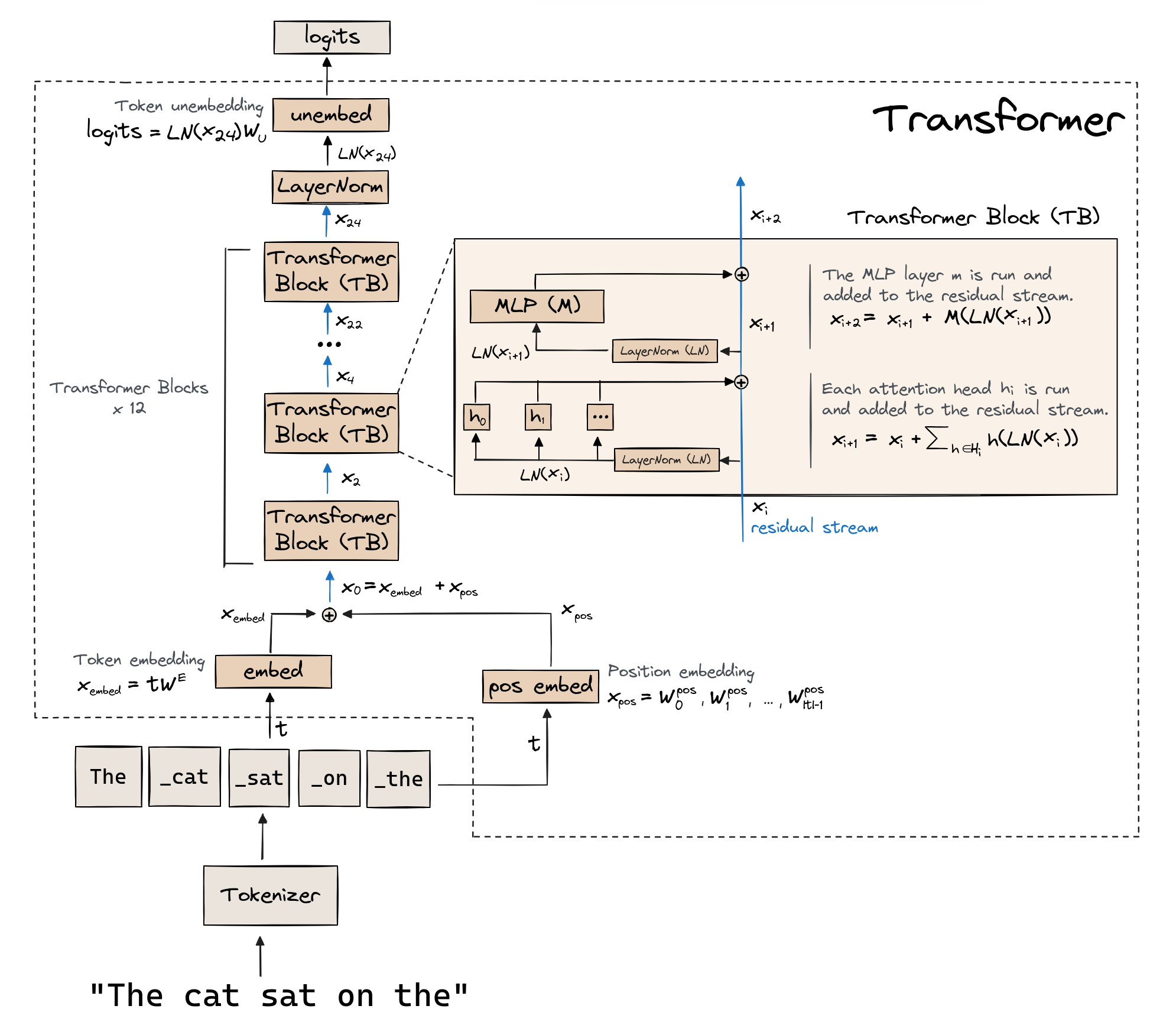
Transformer Glossary
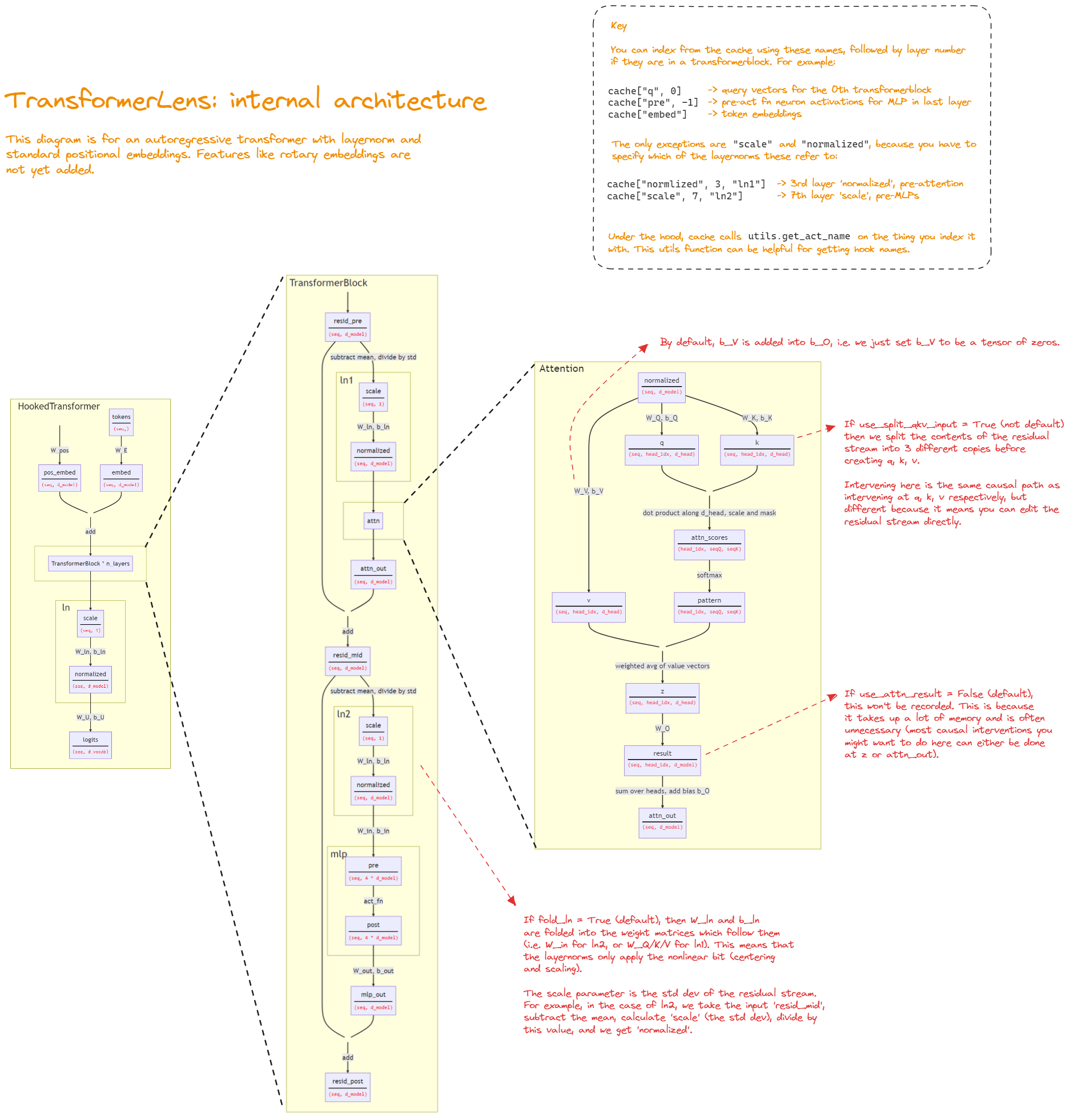
Token Embedding
- lookup table to convert tokens to vectors, shown as matrix , consisting of stack of token embedding vectors.
Residual Stream
- sum of all previous outputs of layers of the model, also sent as input to each new layer. It has shape
[batch, seq_len, d_model](d_modelis length of a single embedding vector). - Initial value denoted as , later as (after more MLP and attention layers applied).
- Fundamental concept of how transformers have memory, move info between layers, and store info that attention moves between positions.
- Residual Stream also used for output accumulation, as it contains collection of all inferences made by model upto a point when it is moving through layers. So taking this RS value midway through model and converting it to tokens gives coherent good predictions.
Transformer Blocks
n_layers, each block contains attention layer and MLP layer, but we say a transformer has k layers if it has k blocks (i.e. 2k total layers).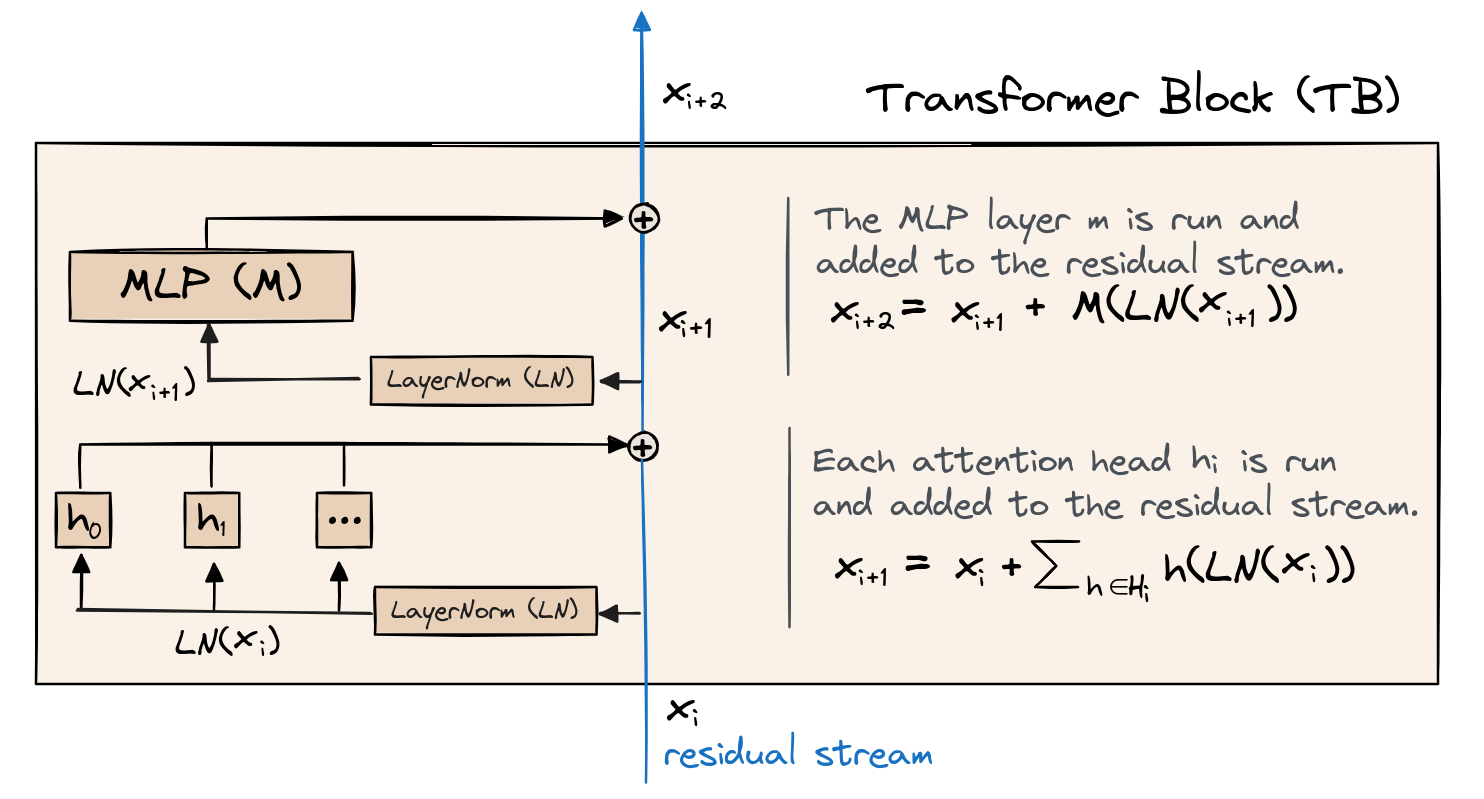
Attention
- move info from prior positions (vectors at diff positions in residual stream) to the current token
- move backwards only to avoid cheating, so later vectors have more seq as input.
n_headsnumber of attention heads, each with own params, settings- attention heads act individually and their outputs are added
- Only transformer part that moves info between positions
- What each head does:
- creates attention pattern for each destination token, basically a probability distribution of all prior + current tokens (distro of how much info to copy)
- moves this attention pattern (linear map) from each source to each destination token.
- Each head has 3 components:
- Query: The question jiske liye info chaiye from all tokens
- Key: Represents which token has info. Token with info to question will have highest dot product (called attention score)
- Value: The actual value taken from token with info.
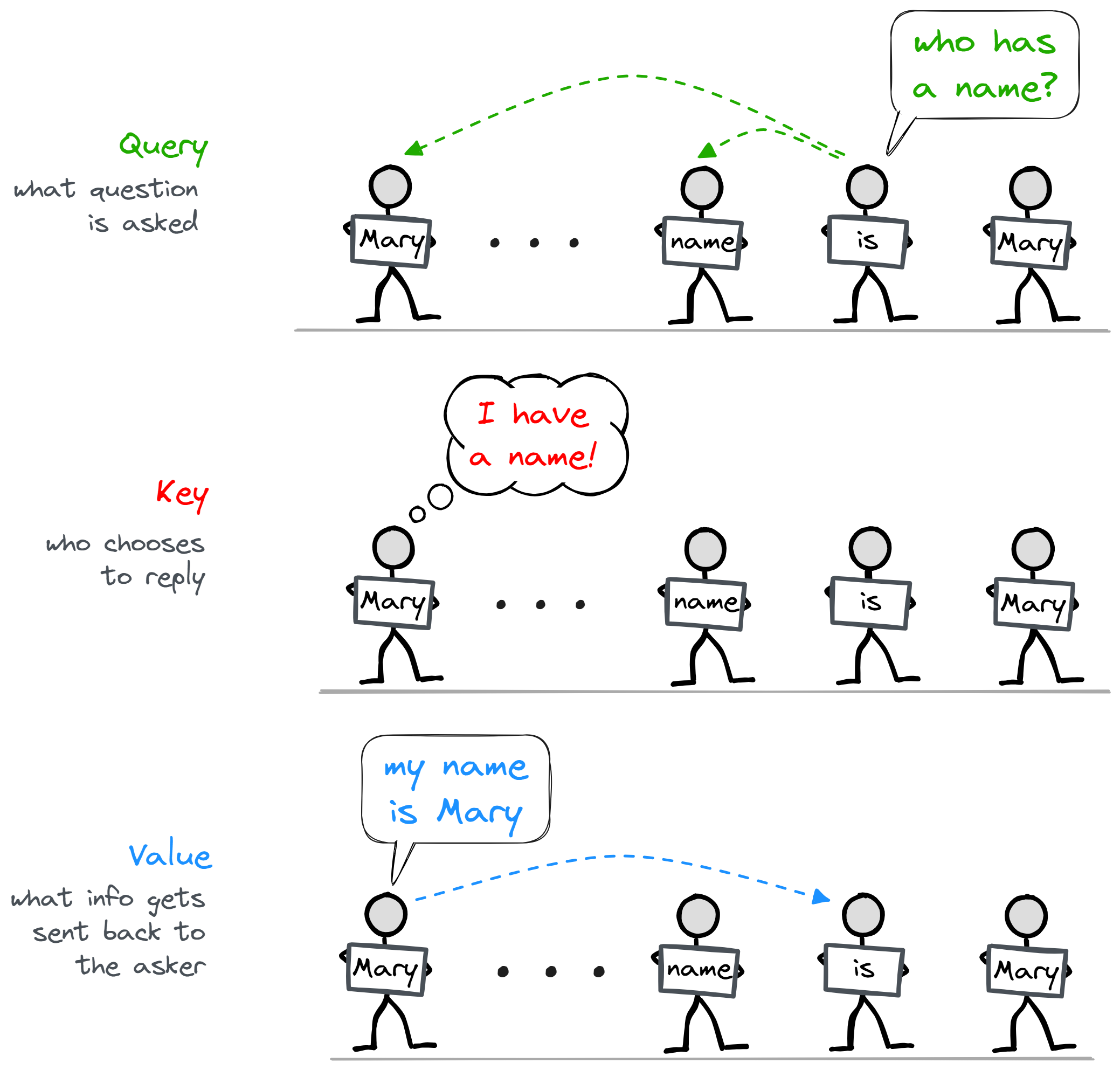
- Attention is a way of “generalized convolution”. Normal convolution = locality based. But language context isn’t always local and words can be important/connected even when they’re not close together. So this helps attention figure out this algo per sentence instead of depending on locality/proximity.
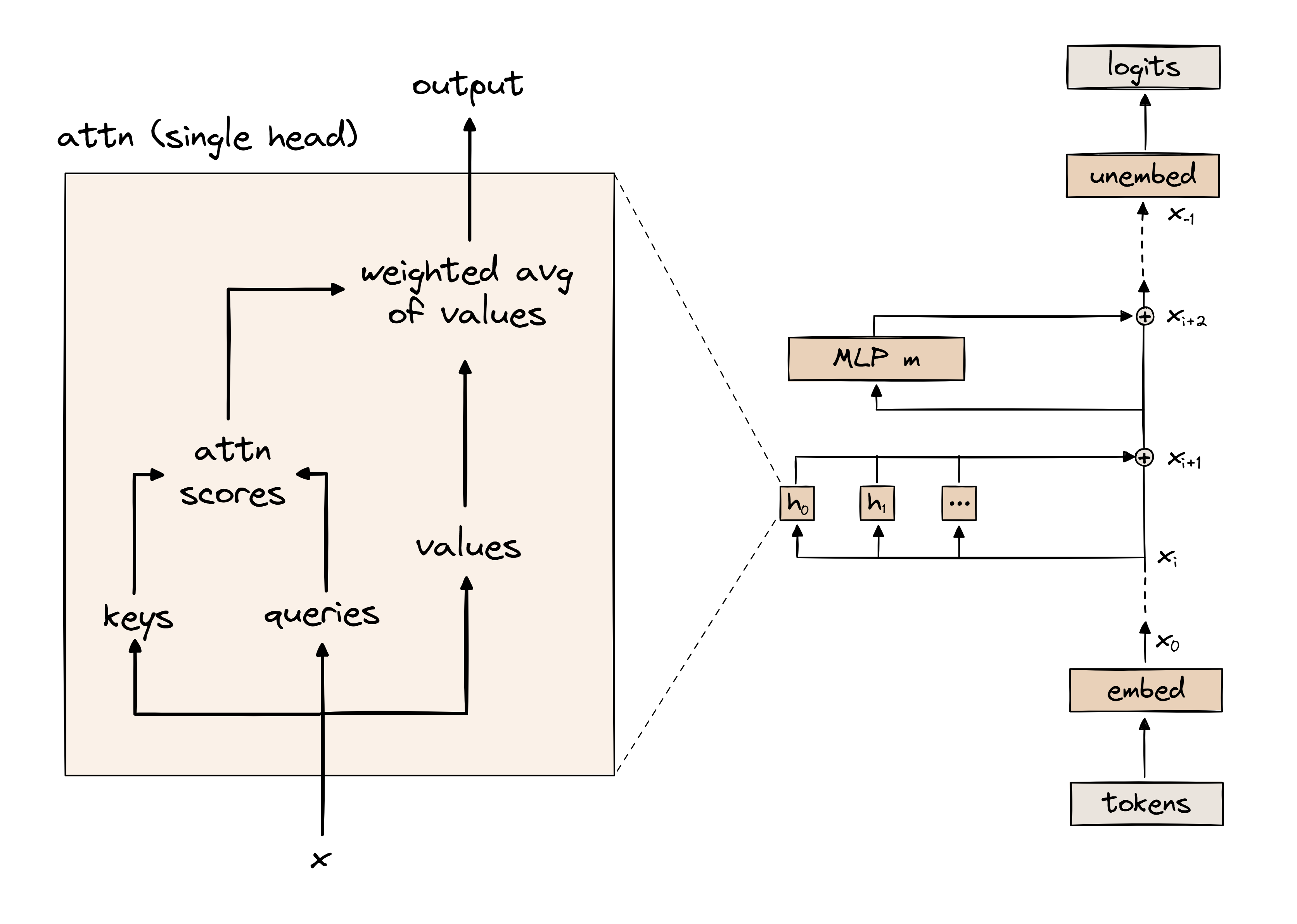
MLP
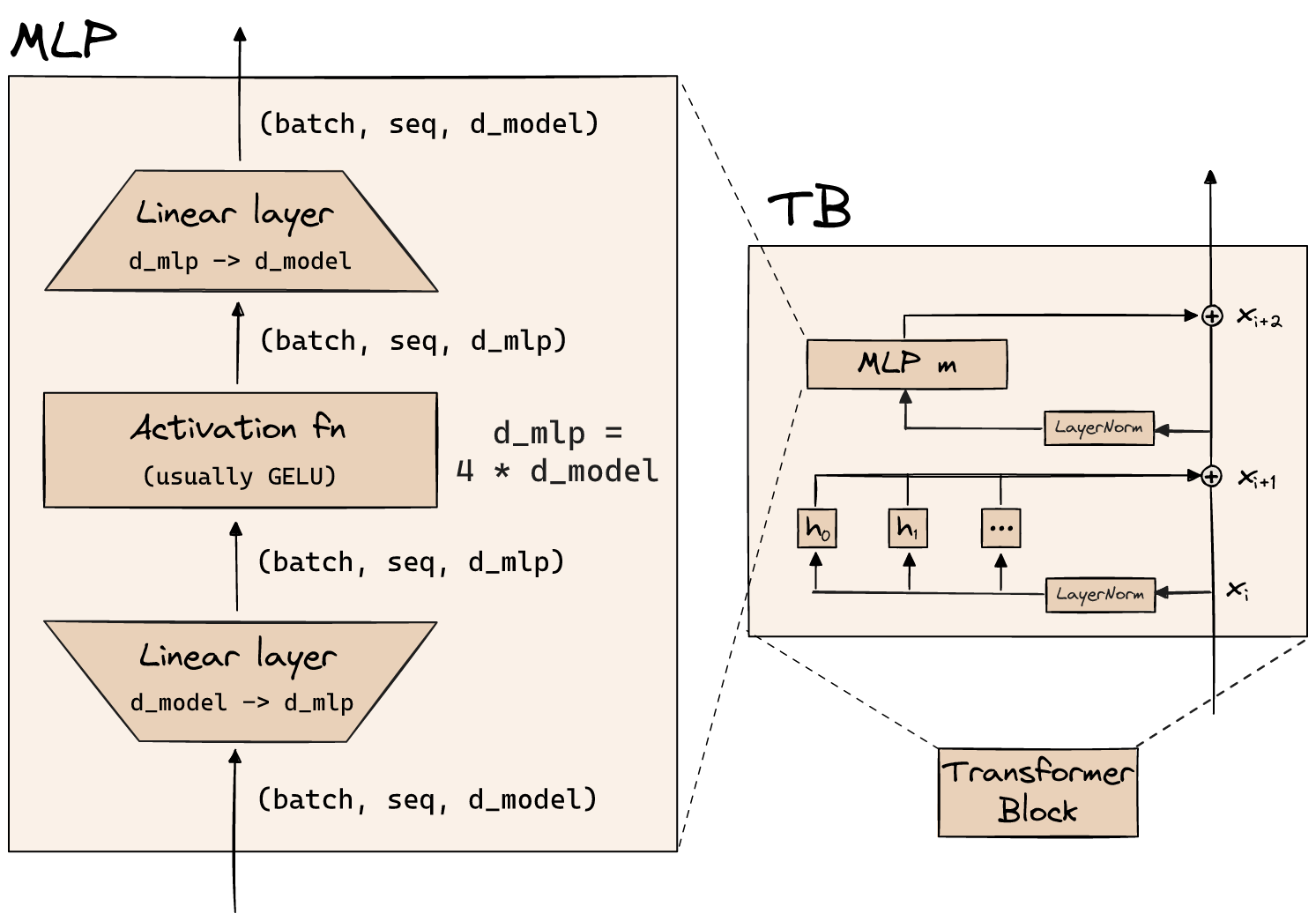
- standard neural network with single hidden layer (
d_mlp = 4 * d_model) and non-linear activation function (GELU) - they don’t move info within blocks they perform thinking/computation for each residual block based on all the info that attention tokens has collected for them from prior tokens.
- comprise 2/3rd of entire transformer components.
- MLP can be re-imagined as key-value pairs:
- MLP output can be written as , where and are the different weights of the MLP, is activation function, and is a vector in the residual stream. This can be rewritten as:
- Here are the input vectors which when activated, write in the direction of output vectors . Similar to key value in attention layers, so they are also called that.
- MLP as a Knowledge Storage in Transformer:
- Key value pairs also an intuition for memory storage in kv pairs.
- Also found evidence for memory management, that each neuron satisfies: for some unit vector . So it might mean that its clearing up positive component of vector in the direction of .
Unembedding
Apply linear map (unembedding matrix) that maps final residual stream to a vector of logits.
Tied Embeddings
- Sometimes models map and together. Meaning the embedding matrix (used to convert token IDs into initial
d_modelvectors) and the unembedding matrix (used to convert finald_modelvectors back into logits) share the same weights. That is,W_Uis often set to be the transpose ofW_E. - This is good for training as there are lesser params to train on.
- Con: assumes a symmetric relationship, that is not causal. Obama has a higher chance of prob after Barack, but not other way around. But single mapping assumes that since these tokens are probable together they can be substituted and also have back-probability.
LayerNorm
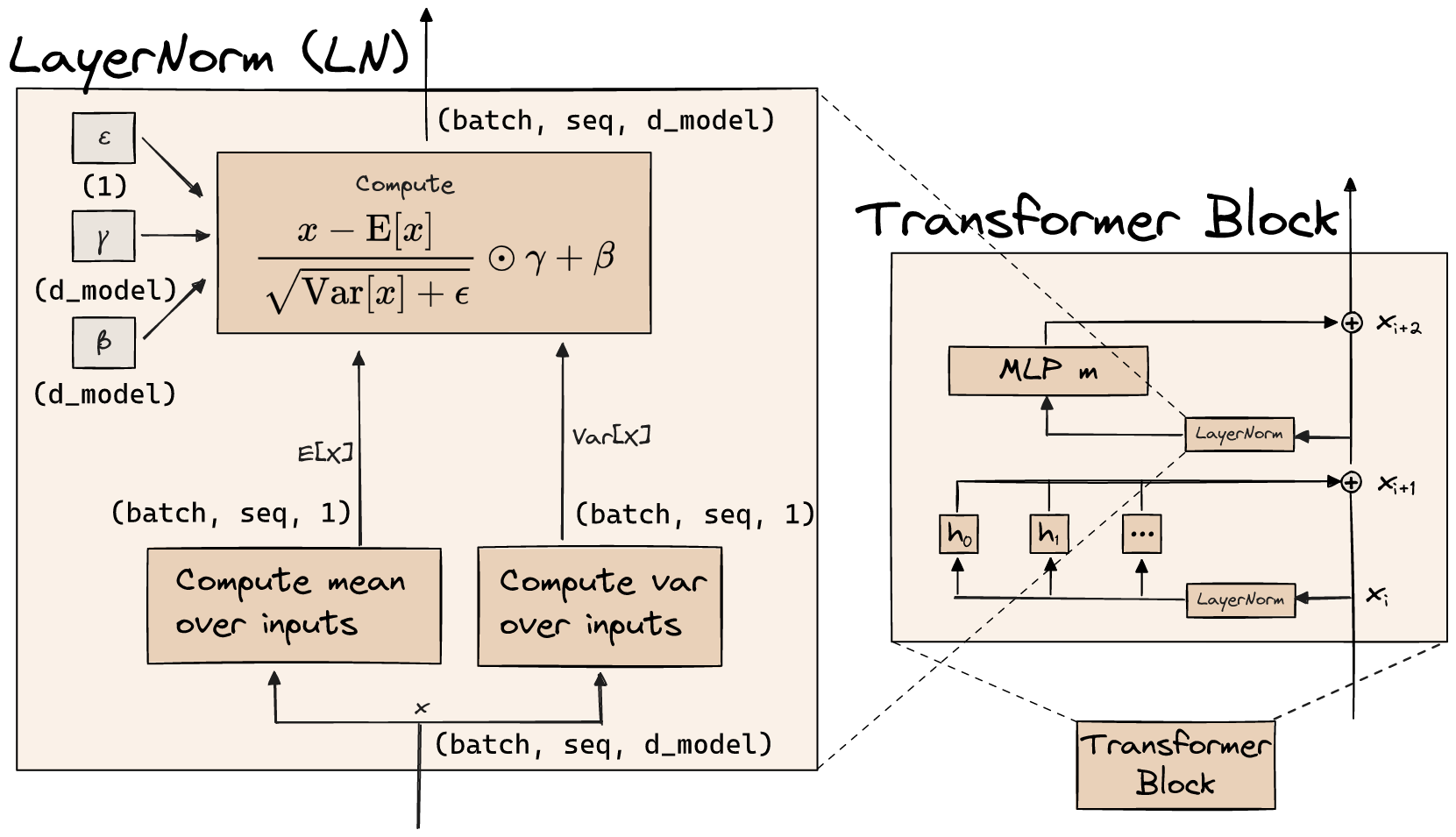
- Simple normalization function at start of each layer (attention head, MLP and before unembed) to convert input vector into vector with 0 mean and 1 variance.
- Applies elementwise scaling and translation.
- Hard for interpretability because dividing by variance makes it hard to separate contribution of each input to the output difficult.
Positional Embeddings
- Problem: currently attention learns symmetric info - info of token 5 from token 1 is same weight as that from token 2, whereas closer tokens should have more importance.
- Solution: Positional embeddings mapping the position of each token to its residual stream vector. This is added to the embed.
- We add and not concatenate inside transformers so that different info pieces can learn from each other instead of creating new entity with separate dimensions.
Code (GPT2 specific)
Activations of first layer in GPT 2 model:
hook_embed                     (1, 35, 768)
hook_pos_embed                 (1, 35, 768)
blocks.0.hook_resid_pre        (1, 35, 768)
blocks.0.ln1.hook_scale        (1, 35, 1)
blocks.0.ln1.hook_normalized   (1, 35, 768)
blocks.0.attn.hook_q           (1, 35, 12, 64)
blocks.0.attn.hook_k           (1, 35, 12, 64)
blocks.0.attn.hook_v           (1, 35, 12, 64)
blocks.0.attn.hook_attn_scores (1, 12, 35, 35)
blocks.0.attn.hook_pattern     (1, 12, 35, 35)
blocks.0.attn.hook_z           (1, 35, 12, 64)
blocks.0.hook_attn_out         (1, 35, 768)
blocks.0.hook_resid_mid        (1, 35, 768)
blocks.0.ln2.hook_scale        (1, 35, 1)
blocks.0.ln2.hook_normalized   (1, 35, 768)
blocks.0.mlp.hook_pre          (1, 35, 3072)
blocks.0.mlp.hook_post         (1, 35, 3072)
blocks.0.hook_mlp_out          (1, 35, 768)
blocks.0.hook_resid_post       (1, 35, 768)
ln_final.hook_scale            (1, 35, 1)
ln_final.hook_normalized (1, 35, 768)- Has 12 blocks.
LayerNorm Impl
...: class LayerNorm(nn.Module):
...:     def __init__(self, cfg: Config):
...:         super().__init__()
...:         self.cfg = cfg
...:         self.w = nn.Parameter(t.ones(cfg.d_model))
...:         self.b = nn.Parameter(t.zeros(cfg.d_model))
...:
...:     def forward(self, residual: Float[Tensor, "batch posn d_model"]) -> Float[Tensor, "batch posn d_model"]:
...:         mean = residual.mean(dim=-1, keepdim=True)
...:         variance = residual.var(unbiased=False, dim=-1, keepdim=True)
...:         z = (residual - mean) / (np.sqrt(variance + self.cfg.layer_norm_eps))
...:         return z*self.w + self.b
Glossary
- Logit - vector x that can be represented by its probability distribution via softmax function:
- Autoregressive - model only predicts future tokens on basis of past tokens.
- Casual Attention - information moves forward (model only knows past x-1 tokens for each xth token.)
- Parameters: weights and biases learnt during training (these values don’t change).
- Activations: functions of the input, temporarily calculated numbers during forward pass, and disappear after forward run is completed. Eg, attention scores and patterns.
Language -> sub-units
- Byte Pair Encoding: start with the 256 ASCII characters as our tokens, and then find the most common pair of tokens, and merge that into a new token. Space is also a token.